Payment references
Every invoice quints renders asks to be paid with a structured reference, so
the payment arrives carrying its own invoice id. That is what lets
quints import and quints match credit an incoming payment to the right
invoice instead of guessing from the amount.
Switzerland has two such references, and they are not interchangeable: each one is tied to a different kind of bank account, and picking the wrong pair produces a QR-bill banks reject. quints picks the Swiss-native pair whenever your bank account can carry it, and the ISO one otherwise — and lets you say so explicitly when you want the other.
The three reference types
The Swiss QR-bill defines three, in the Tp element of the QR code:1
| Type | Looks like | Account it needs | Currencies |
|---|---|---|---|
| QRR — QR reference | 12 34561 00841 17000 00202 60143 |
QR-IBAN only | CHF only |
| SCOR — Creditor Reference (ISO 11649) | RF47 INV2 0260 14 |
regular IBAN only | CHF and EUR |
| NON — no reference | (empty) | regular IBAN | CHF and EUR |
The pairing is a hard rule of the standard, not a convention:
Must contain the code QRR where a QR-IBAN is used; where the IBAN is used, either the SCOR or NON code can be entered.
and, for the QR reference and the QR-IBAN specifically:
[The QR reference] can only be used in combination with a QR-IBAN … [and] for invoicing in CHF. … The reference must not consist exclusively of zeros.
[The QR-IBAN] can only be used for invoicing and payments in CHF.
So QR-IBAN + SCOR, IBAN + QRR and QR-IBAN in EUR are all invalid. quints never emits any of them: it resolves the valid pair from your account, and refuses an explicit setting that would break the rule rather than quietly substituting another.
Side by side
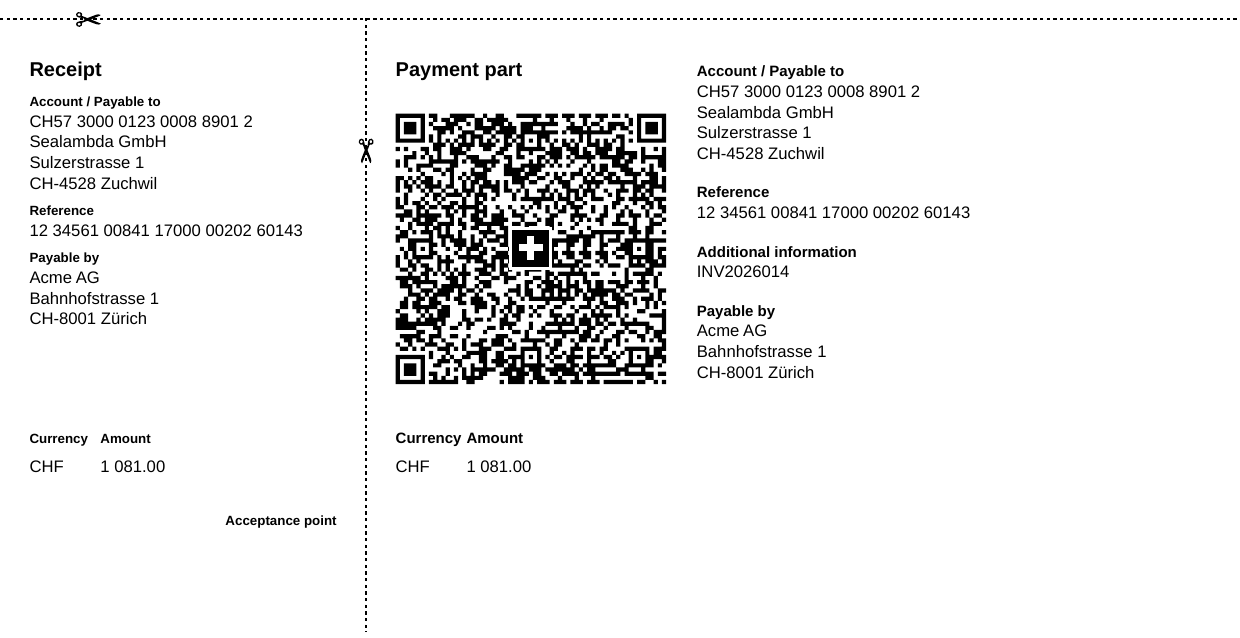
The same invoice under each scheme — the payment part is what the customer scans or retypes. With a QR-IBAN and the bank's identification, a QR reference whose tail is the invoice's own digits:
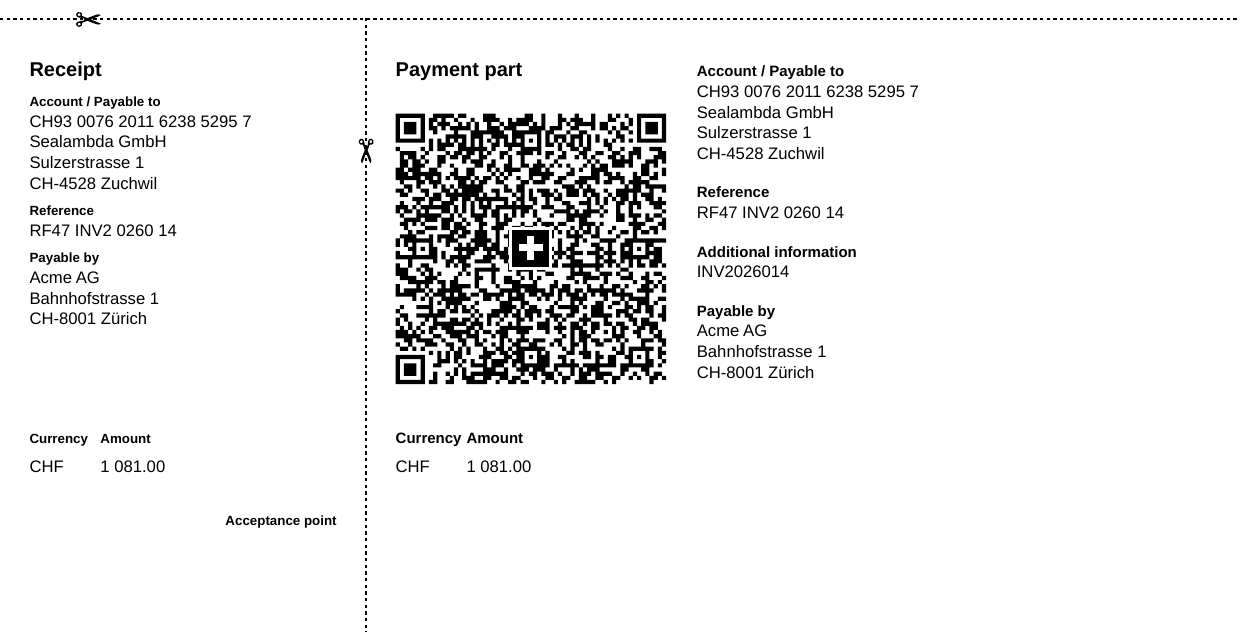
With the regular IBAN, a creditor reference that spells the invoice number out:
A QR-IBAN is a second account number
This is the part that trips people up. A QR-IBAN is not a formatting variant of your IBAN — it is a separate number your bank issues you, recognisable by an institution id in the 30000–31999 range:
Every bank in the scheme owns exactly one QR-IID, listed in SIX's bank master
(PostFinance 30000, UBS 30005, Raiffeisen 30808, …). Validators check against
that list: the Guidelines' own sample QR-IBAN, CH44 3199 9123 0008 8901 2,
sits on 31999, which no bank owns, so UBS's QR-bill portal answers it with
"Please correct the QR IID". quints' samples therefore carry PostFinance's
30000 — valid, belonging to nobody, and accepted by such checks.
Both can point at the same underlying account, but they are addressed
separately, and a QR-IBAN cannot receive an ordinary credit transfer at all. An
invoice paid from abroad therefore needs the regular IBAN — which is why an
export invoice in quints always carries SCOR, and why you keep iban next to
qr_iban even when your QR-bills use the QR reference.
Which one should you use?
QRR with a QR-IBAN, if your bank gives you one. It is the Swiss-native
scheme — the direct successor of the orange ESR/BVR payment slip — and the one
Swiss accounts-payable departments and e-banking apps are built around. Its
decisive property: the payer's bank refuses any payment to a QR-IBAN that
does not carry a valid QR reference. The reference cannot be forgotten,
mistyped or left off a manual transfer, so every payment that reaches you is
matchable. Banks also process these payments as reference payments (the ESR
successor product), which is what their reconciliation tooling keys on. quints
uses QRR automatically as soon as the account has a qr_iban.
The costs: it is numeric (quints keeps your invoice's digits visible in it — see below), CHF-only, Switzerland-and-Liechtenstein-only, and it needs two things from your bank — the QR-IBAN and the six-digit identification that has to lead every reference you issue.
SCOR with your regular IBAN, when you have no QR-IBAN or want one readable
reference everywhere. It works with the account number you already have,
is valid on a QR-bill in CHF and EUR, travels in SEPA transfers so a foreign
customer quotes the same reference a domestic one does, and it spells out the
invoice number: RF47 INV2 0260 14 is readable on a bank statement and
quotable in a reminder email. quints uses it for every account without a
qr_iban, for every QR-bill in EUR, and for every export invoice.
Its cost is the mirror image of QRR's strength: on a regular IBAN the reference is optional for the payer. Someone who types the transfer by hand instead of scanning can leave it out, and that payment arrives with an amount and a name only — quints then falls back to scoring by payee and amount and asks you to confirm.
Prefer SCOR although you have a QR-IBAN? Set reference: scor on the
account. The QR-IBAN stays on file and unused; QR-bills go out with RF
references paid into the regular iban.
NON is not supported by quints. The standard allows a QR-bill with no
reference at all, but every quints invoice derives its reference from the
invoice number — that is the premise quints match is built on. A bill with no
reference would arrive as an amount and a date, which is exactly the
reconciliation problem quints exists to remove.
What the QR reference contains
A QR reference is 26 digits plus a check digit, and it may not carry letters. quints encodes the invoice number into it so that a human can still recognise the invoice on a statement:
INV2026014, bank id 123456 →  12 34561 00841 17000 00202 60143
                              ^^^^^^ ^ ^^^^^^^ ^^^^^^^^^^^^ ^
                              bank id | letters      digits  check digit
                                      form
- the first six digits are the identification your bank assigned you
(
qr_reference_id; zeros if you have not configured one); - one digit names the form.
1is the legible form for the usual shape of invoice number — up to four letters, then digits: a block holding the letters, then the digits themselves, right-aligned, so the reference ends in…2026014; 2is the fallback for any other shape (ACAD202608B), an opaque bijective-base-36 encoding;- the last digit is the modulo-10 check digit every QR reference carries.
Both forms are injective — INV0042 and INV42 never share a reference — and
both decode: quints import and quints match turn a QR reference from a bank
statement back into the invoice number without needing your bank id. Twelve
letters-and-digits is the most a reference carries; a longer invoice number is
refused when the file loads rather than truncated, because a truncated
reference is a payment credited to somebody else's invoice. The same rule caps
a SCOR reference at 21 characters.
Configuring it
The account's reference scheme lives in invoicing/issuer.yaml, per currency.
An account with only a regular iban pays by SCOR — nothing to declare:
bank:
  CHF:
    iban: CH93 0076 2011 6238 5295 7
    bic: POFICHBEXXX
    bank_name: PostFinance AG, Bern
  EUR:
    iban: DE89 3704 0044 0532 0130 00
    bic: COBADEFFXXX
Add the QR-IBAN and CHF QR-bills switch to QRR, paid into it. Add the six-digit
identification your bank assigns you (UBS calls it the BESR-ID) — banks
require it as the first six digits of every reference you issue, and without
it your references go out starting 000000:
bank:
  CHF:
    qr_iban: CH57 3000 0123 0008 8901 2
    qr_reference_id: "123456"   # quoted — YAML reads a bare leading zero as octal
    iban: CH93 0076 2011 6238 5295 7   # keep it: CHF from abroad needs it
    bic: POFICHBEXXX
To keep the QR-IBAN on file but issue RF references anyway, say so:
reference: qrr is accepted too, and means the same as leaving it out on an
account that has a qr_iban — except that it is an error on an account that
has none, or on a QR-bill in EUR, instead of a fallback.
How quints resolves it
| Account has | Invoice | Reference |
|---|---|---|
iban only |
domestic | SCOR, into iban |
qr_iban, with or without iban |
domestic, CHF | QRR, into qr_iban |
qr_iban and iban |
domestic, EUR | SCOR, into iban — the QR scheme is CHF-only |
qr_iban only |
domestic, EUR | error — add an iban |
reference: scor |
domestic | SCOR, into iban (error if there is none) |
reference: qrr |
domestic, CHF | QRR, into qr_iban (error if there is none) |
reference: qrr |
domestic, EUR | error — CHF only |
| any | export | SCOR (a credit transfer has no QR-bill) |
quints invoice prints what it used, so the scheme is visible on every render:
and quints invoice … --json carries it as reference and reference_type.
Checking an account before it ships
checks every IBAN and BIC in the issuer config — length, national layout,
mod-97 check digits, ISO 9362 for the BIC — and reports the institution behind
Swiss and Liechtenstein IBANs, so you can see at a glance whether a number you
pasted as qr_iban really carries a QR-IID (30000–31999). It exits non-zero
when something is off, which makes it a usable pre-flight check.
Overriding a single invoice
Set reference: on the invoice only to re-issue one that originally went out
with a reference produced elsewhere:
It is validated by its own check digits when the file loads, and refused if it doesn't match the scheme the account resolves to — you cannot staple a QR reference onto an account that pays by SCOR.
When the payment comes back
quints import and quints match read the references out of a payment's
details — QR references however the bank groups them, with or without their
leading zeros; RF references with or without spaces; the plain invoice number
as a whole word — verify their check digits, decode a QR reference back into
its invoice number, and match exactly, never by substring: a payment for
ACAD202608B is never credited to ACAD202608. Invoices issued before this
scheme, with the old zero-padded reference, still clear. A reference that fits
more than one open invoice matches nothing; the draft stays flagged ! and
quints match says why. See Import statements.
-
Swiss Implementation Guidelines QR-bill, sections 2.10 (QR-IBAN), 2.12.1 (QR reference), 2.12.2 (Creditor Reference) and the
RmtInf/Tp,RmtInf/Refdata elements. Version 2.4 (24 February 2026) is valid from 14 November 2026 and replaces version 2.3 of 21 November 2025, which stays valid until November 2027. The one difference that matters here: from 2.4 a QR-bill in EUR can only be IBAN + SCOR or IBAN + unstructured message — the QR scheme is CHF-only. ↩